


How the Kachwahas made a kingdom

An argued name: Dhundhar may come from a hill called Dhundh near Jobner, west of Jaipur, or from a small river of the same name.
Before the Kachwahas: it was the country of the Meena chiefs and smaller Rajput houses.
Dulha Rai: a Kachwaha prince from the country around Gwalior took Dausa and then Khoh, and his descendants took Amer from the Meenas.
- Founder in Dhundhar
- Dulha Rai, from near Gwalior
- Mughal alliance
- 1562
- Jaipur founded
- 1727
- Breakaway states
- Alwar and Shekhawati
- Uncertain dates: the chronicles disagree by more than a century, so we won't pretend to know them. For most of the next seven hundred years the Kachwahas ruled from those hills.
- The Mughal marriage: in 1562 Raja Bharmal of Amer gave his daughter in marriage to Akbar, and the Kachwahas became the empire's closest Rajput allies.
- Raja Man Singh I: Bharmal's grandson, one of Akbar's greatest generals, governed provinces from Kabul to Bengal. His wealth built the palace at Amber Fort.
- Mirza Raja Jai Singh I: served Shah Jahan and Aurangzeb.
- Sawai Jai Singh II: the astronomer-king moved the capital down to the plain and founded Jaipur in 1727.
- Thikanas: nobles held their own estates from their own forts.
- Branches that broke away: the Naruka Kachwahas founded Alwar in the eighteenth century, and the Shekhawat Kachwahas carved out Shekhawati to the north.
- Into Rajasthan: Maharaja Sawai Man Singh II became the new state's first Rajpramukh, its ceremonial head, and Jaipur its capital.
- The family today: it still lives in the City Palace, and the old city still calls its head Maharaj without thinking twice.
Hills, salt and farmland

The eastern Aravallis: the old hills break into separate ridges with flat, farmed valleys between.
Winter colours: yellow mustard and green wheat and gram.
- The Banas: most of the region drains towards it.
- Before the monsoon: dry, dusty and hot.
- After the rains: a green that surprises everyone who has only seen photographs of the desert.
- To the west: the land flattens to the salt lake at Sambhar, then rises into the rugged hills around Ajmer and Pushkar.
- To the north-east: the forested ridges of Alwar and Sariska still shelter leopards, sambar deer and, in Sariska, a small population of tigers.
- Walls on every hill: the Kachwahas and their nobles built forts, watchtowers and garden retreats wherever a ridge gave a view, and many are now among India's best places to stay.
The people, the speech and the dress
Dhundhari: also called Jaipuri, the everyday language of Jaipur, Dausa, Tonk and the villages between. Older people mix it freely with Hindi.
At home: our children use it when they tease their grandparents.
- Greetings: padharo sa, please come in, at every doorway, and khamma ghani, the formal Rajasthani hello.
- Village women: a full ghaghra skirt, a short blouse and a long odhni head-cloth, often in bright tie-dye.
- Leheriya: wave-patterned tie-dye worn by Jaipur's women for Teej in the monsoon.
- Turbans: the safa or pagri changes style and colour from district to district. Jaipur's royal pink-and-saffron safa is worn at weddings and festivals.
- The Meenas: whose chiefs held this land before the Kachwahas, still one of the region's largest communities.
- The Gujjars: herders who keep cattle and buffalo in villages around Amer and Alwar.
The places of Dhundhar, one by one
Jaipur, the Pink City
A planned capital: Sawai Jai Singh II laid it out on a grid of blocks, broad bazaars and great squares. The walled city is a UNESCO World Heritage Site.
- Inside: the City Palace, the Jantar Mantar observatory, Hawa Mahal and the bazaars of jewellers, bangle-makers and brass-workers.
- Allow: three nights at least, in a palace hotel such as Rambagh or The Oberoi Rajvilas.
Amer and Nahargarh
The old capital: eleven kilometres north of Jaipur, climbing the hill above Maota Lake.
Amber Fort: its palace holds the Sheesh Mahal, the hall of mirrors.
- The village below: the geometric Panna Meena ka Kund stepwell, the Jagat Shiromani temple and the Anokhi Museum of Hand Printing.
- On the ridge: Nahargarh and Jaigarh stand guard.
- Timing: arrive as the fort opens, before the crowds.
Samode
The palace: about an hour north-west of Jaipur, a sixteenth-century fort rebuilt in the nineteenth century by the Rawals of Samode, ministers at the Jaipur court.
- Its rooms: a Durbar Hall and a Sheesh Mahal painted and mirrored as richly as anything in the City Palace.
- A hotel since 1987: still owned by the family. Come for lunch, or better, stay the night.
Abhaneri and the Chand Baori
On the Agra road: about two hours east of Jaipur.
- The stepwell: usually dated to the eighth or ninth century and often credited to a king named Chanda, one of India's deepest.
- Thirteen storeys: criss-cross steps drop to a pool of green water.
- Harshat Mata: the ruined temple beside it is from the same period, with beautiful carvings.
Sambhar Lake
India's largest inland salt lake: south-west of Jaipur, growing and shrinking with the rains.
- Salt and birds: salt has been made here for centuries, it became a Ramsar wetland in 1990, and winter brings flamingos in their thousands.
- How to visit: sunrise with a birding guide, then the temple of Shakambhari Mata, the goddess the town is named after.
Bhangarh
Founded: in the late sixteenth century as the seat of Madho Singh, a younger son of Raja Bhagwant Das of Amer.
- Roofless: its bazaar, temples and palace stand in the scrub on the edge of the Sariska hills.
- The legend: known as India's most haunted fort, and the archaeological department forbids entry at night.
- Our way: soft morning light for the ruins, and the ghost stories left to the guides.
Alwar
A breakaway state: founded in the eighteenth century by Pratap Singh, a Naruka Kachwaha, and home to one of Rajasthan's most extravagant courts.
- Sights: Bala Quila above the old city palace, and the chhatri of Moosi Maharani beside its tank.
- Siliserh: a lake with a nineteenth-century palace, a short drive away.
- Also: the gateway to Sariska, and famous across India for its milk cake.
Pushkar
Over the hills from Ajmer: a small sacred lake lined with bathing ghats.
- Brahma: one of the very few temples in India dedicated to the creator.
- The fair: in October or November the Pushkar Camel Fair fills the dunes beside town.
- Holy rules: vegetarian and alcohol-free, and best at the ghats at dawn and dusk.
Ajmer
Never Kachwaha land: a Chauhan capital, then a Mughal stronghold, then, after a spell under the Marathas, a British province governed directly.
- The dargah: of Khwaja Moinuddin Chishti, the Sufi saint who died here in the thirteenth century, where people of every faith pray.
- Nearby: the Adhai Din ka Jhonpra, one of India's oldest mosques, and Ana Sagar lake.
Kishangarh
A Rathore state: founded in the early seventeenth century by a prince of Jodhpur, outside the Kachwaha story.
- Miniatures: its eighteenth-century court painters created one of India's loveliest schools.
- Bani Thani: the famous portrait with elongated eyes is credited to Nihal Chand under Raja Sawant Singh.
- Today: a huge marble market, and its old palace by Gundolav lake is a quiet stop on the Pushkar road.
What Dhundhar eats

Pyaaz kachori: Jaipur's breakfast, a flaky pastry stuffed with spiced onion, with thick lassi in clay cups.
Gatte ki sabzi: gram-flour dumplings in a yoghurt curry.
Dal baati churma: hard wheat rolls baked in coals, broken into lentils, soaked in ghee and followed by sweet crumbled churma.
- Laal maas: the royal kitchens' mutton in a fierce red gravy of dried chillies.
- Safed maas: its pale, creamy cousin, with cashews and yoghurt.
- Ghevar: a honeycomb disc of fried batter soaked in syrup, only in the monsoon around Teej.
- Til patti: sesame brittle that comes with the kites in January.
- Alwar's milk cake: a grainy, caramelised cousin of kalakand, sold all over north India.
- Pilgrim sweets: Pushkar's malpua pancakes, and vast pots of sweet rice cooked in Ajmer's dargah bazaar.
- Where we eat: our food of Jaipur guide and the dishes in our Rajasthani food guide.
Crafts of the Kachwaha court
Gemstones: Jaipur is one of the world's great centres for cutting coloured stones, especially emeralds.
Meenakari: bright enamel work set behind gold jewellery.
- Sanganer and Bagru: printing villages that stamp cotton with hand-carved wooden blocks.
- Blue pottery: Jaipur's own, made from quartz rather than clay and painted in cobalt.
- Kishangarh painters: still working in the old miniature style. Our miniature painting guide shows how to tell careful work from a quick copy.
- Lac bangles: shaped over charcoal in Jaipur's Maniharon ka Rasta.
- Jaipuri razai: cotton quilts so light they fold into a small bag, still made by hand.
- Makers, not showrooms: we take guests to the families, never to commission shops. See our shopping guide.
Dhundhar's year of festivals
- Makar Sankranti
- 14 January
- Gangaur
- Spring
- Teej
- The monsoon
- Pushkar Fair
- Kartik full moon, October or November
- Urs at Ajmer
- Moves with the Islamic calendar
Makar Sankranti, 14 January
- The kite day: all of Jaipur goes up on the roof, from first light until lanterns go up after dark.
- The sky: never fuller over the walled city.
Gangaur and Teej
- Women's festivals: of spring and the monsoon.
- The procession: in Jaipur both end with the goddess carried from the City Palace through Tripolia Gate, with women in their best leheriya lining the route.
The Pushkar Camel Fair
- Camels and pilgrims: herders trade on the dunes while pilgrims bathe in the lake.
- Go early: the first days are when the trading is real.
The Urs at Ajmer
- The saint's anniversary: vast crowds come for several days of prayer and qawwali.
- Moving dates: it follows the Islamic lunar calendar.
The Abhaneri Festival
- A lit stepwell as a stage: a small festival of folk music and dance at the Chand Baori, one of Rajasthan's most magical settings for a performance.
Where to stay in Dhundhar
In Jaipur
Rambagh Palace: the grand old royal residence.
- The Oberoi Rajvilas: a calm walled garden outside the city.
- Samode Haveli: inside the old walls.
- Compare the rest: luxury hotels in Jaipur.
In the country
Samode Palace: a painted palace in a village valley.
- Alila Fort Bishangarh: a warrior fort on a granite hill, restored as a hotel.
- Neemrana Fort-Palace: terraces climbing a hillside towards Delhi, a good first or last night.
- Pushkar: our guide to luxury stays in Pushkar, including the tented camps that open for the fair.
How we'd travel Dhundhar

Jaipur first: three or four nights, with Amer, Galtaji and Bagru as half-day trips.
Then the country: a night at Samode or Bishangarh.
Then the holy towns: two nights in Pushkar, visiting Ajmer and Kishangarh on the way.
- Amer
- About half an hour
- Samode
- About an hour
- Abhaneri
- About two hours east
- Bhangarh
- About two and a half hours
- Ajmer
- About two and a half hours
- Alwar
- About three hours
- Towards Agra: Abhaneri fits neatly into the drive.
- Towards Delhi: Bhangarh and Alwar suit a night near Sariska.
- Journeys that start here: Jaipur in three nights and sacred Rajasthan.
- Flights and trains: Jaipur International Airport (JAI) links Delhi, Mumbai, Udaipur and more, and fast trains from Delhi take a little over four hours.
- West of Jaipur: Sambhar about two hours, Kishangarh about an hour and a half, and Pushkar half an hour beyond Ajmer.
- Alwar from Delhi: roughly three hours, the same as from Jaipur.
When to come to Dhundhar
The cool months: warm, dry days and cool nights.
Cold dawns: in December and January you can see your breath at Amer.
- Season
- October to March
- Coldest mornings
- December and January
- Hot months
- April to June
- Monsoon
- July to September
- Winter birds: flamingos at Sambhar and migrant ducks on Man Sagar Lake.
- Summer: by April the heat builds, and May and June regularly pass 40°C, so we plan early mornings and long lunches in the shade.
- The underrated monsoon: the Aravallis turn green, stepwells and tanks fill, and the city celebrates Teej.
- Quiet season: Pushkar is at its calmest and the palace hotels are almost empty.
- Month by month: the best time to visit Jaipur.
What most visitors to Dhundhar miss
The city's architect: Sawai Jai Singh II planned Jaipur with the Bengali scholar Vidyadhar Bhattacharya.
Why it is pink: in 1876 Maharaja Ram Singh II had the walled city washed in terracotta pink to welcome the Prince of Wales, the future Edward VII.
- Jantar Mantar on UNESCO list
- 2010
- Amber Fort on UNESCO list
- 2013, Hill Forts
- Walled city on UNESCO list
- 2019
- Hawa Mahal built
- 1799
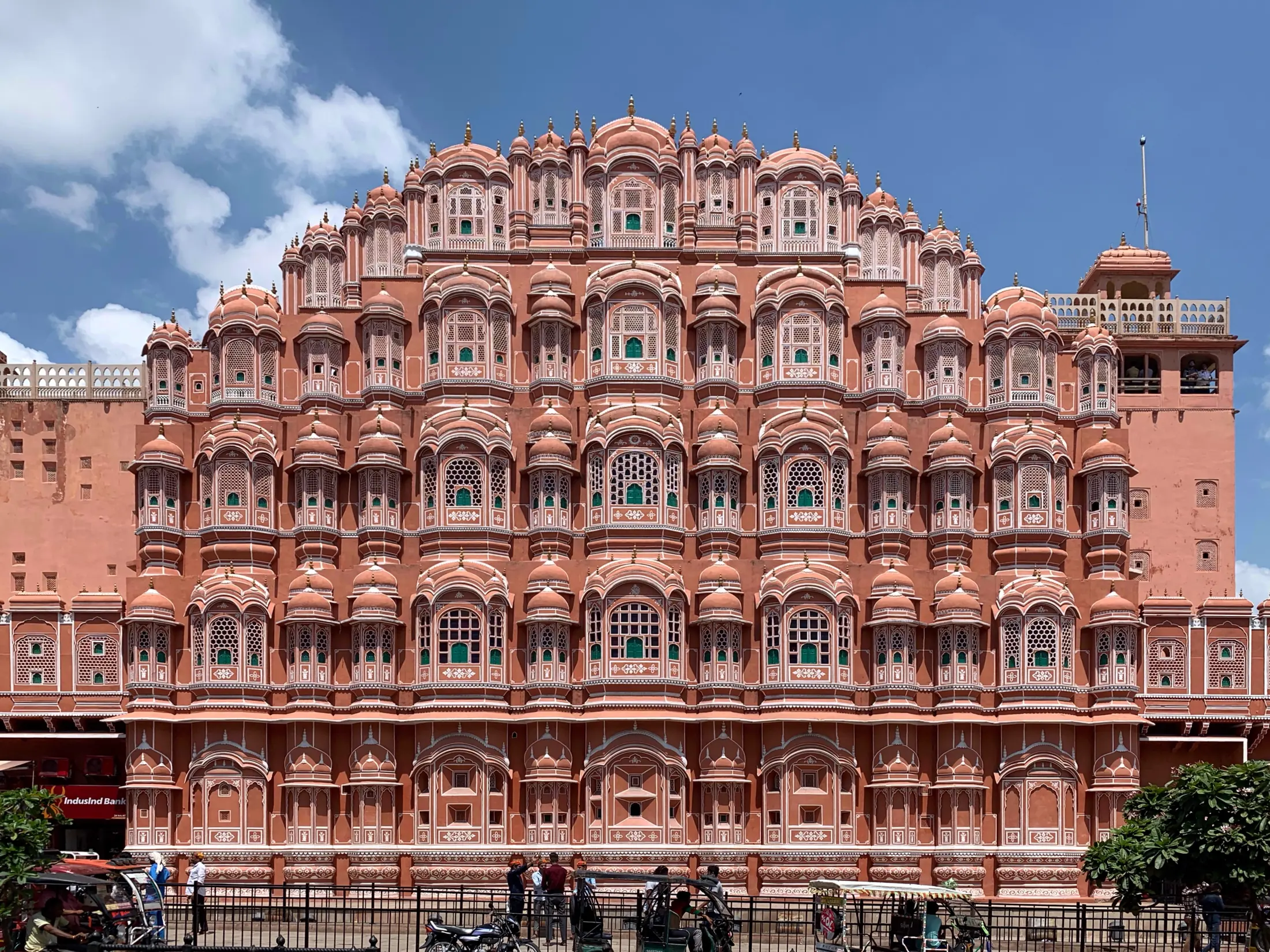
- Hawa Mahal: the palace of winds was built in 1799 by Sawai Pratap Singh, so the royal women could watch street processions unseen.
- Three UNESCO listings: the Jantar Mantar in 2010, Amber Fort among the Hill Forts in 2013 and the walled city in 2019.
- Galtaji: a temple complex of sacred tanks in a gorge just east of the city, where pilgrims bathe and monkeys rule the steps.
What we'd tell our own cousins
A scarf in your bag: shoes off at every temple and dargah, and head covered at Ajmer Sharif.
Pushkar flower trick: never let anyone at the ghats press flowers into your hands and then ask for a donation. Pray only through your own guide or a priest you have chosen.
- No elephant rides at Amer: walk the old ramp in the cool of the morning, or drive to the upper gate.
- Say no to the driver's shop: commission shopping is the region's oldest trap.
- Pushkar is holy: no eggs, meat or alcohol, and public affection is frowned upon.
- Ask about villages: almost everyone in Jaipur has roots in a Dhundhar village, and the stories are wonderful.