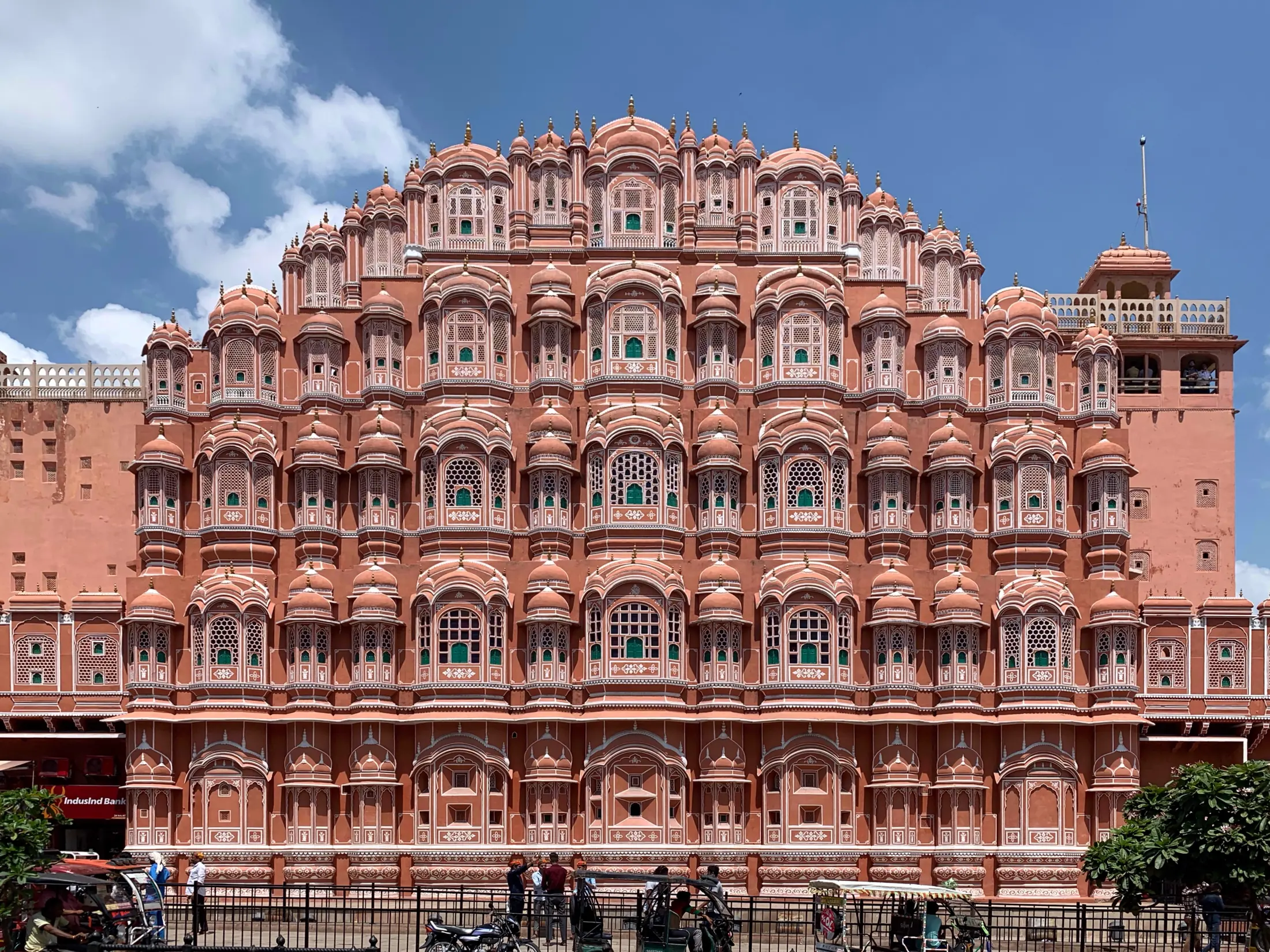
A city drawn by an astronomer

Why the kings moved: the Kachwahas had ruled from the hill fortress of Amer for six centuries and outgrew it. Water was short and the town was cramped.
A scholar-king: Sawai Jai Singh II was a mathematician who corresponded with astronomers across Asia and Europe, and he had larger ideas.
Built by the book: with the scholar-architect Vidyadhar Bhattacharya, he laid out the new capital on the plain below Amer in 1727, following the old Indian texts on architecture.
- Founded
- 1727, by Sawai Jai Singh II
- Planned with
- Vidyadhar Bhattacharya
- Painted pink
- 1876, for the Prince of Wales
- UNESCO listings
- Jantar Mantar 2010, Amber 2013, walled city 2019
- Population
- More than three million
- The grid: nine rectangular blocks, broad straight bazaars meeting at great squares called chaupars, and a palace at the heart of it all.
- Lanes named for trades: our grandparents still called the old city by its rastas, lanes given to brass-workers, bangle-makers and the families who copied manuscripts.
- The trades are still there: on Maniharon ka Rasta off Tripolia Bazaar, lac bangles are still shaped over charcoal. Johari Bazaar is still the jewellers' quarter, exactly as planned nearly three hundred years ago.
- Why it's pink: in 1876 Maharaja Ram Singh II had the walled city washed in terracotta to welcome the Prince of Wales, the future Edward VII. A law has kept it that colour ever since.
- Gerua or gulabi: that's what locals call the shade. It shifts with the hour, from coral in the morning to a deep rose at dusk.
- Three UNESCO listings: the walled city (2019) joined the Jantar Mantar observatory (2010) and Amber Fort (2013, as one of the hill forts of Rajasthan).
- Still a royal city: the former ruling family lives in the City Palace, and a flag flies over the Chandra Mahal when the head of the family is at home.
- And a working one: Jaipur is a city of more than three million people, with traffic, weddings, cricket and tea stalls.
Inside the pink walls
Walk it early: the old city makes sense on foot, before the traffic thickens and the shops open.
- Best time to walk
- Just after sunrise, before the shutters lift
- The spine
- Chandpole Gate to Badi Chaupar, about 2.5 km
- Hawa Mahal
- Built 1799, 953 small windows
- Bring
- Small notes, a scarf, comfortable shoes
- Follow the spine: Chandpole Gate, east along Chandpole Bazaar to Choti Chaupar, then Tripolia Bazaar past the triple-arched Tripolia Gate, out at Badi Chaupar beside Hawa Mahal. That line is the city Jai Singh designed.
- Go round the back of Hawa Mahal: everyone photographs the facade, few climb inside. It was built for the royal women to watch processions unseen, and its windows funnel the breeze through the building.
- Catch the light: just after sunrise the morning sun falls full on the facade while the street below still sleeps.
Johari Bazaar, the jewellers' street
Why it matters: Jaipur is one of the world's great centres for cutting coloured gemstones, especially emeralds, and the trade lives here and in the lanes behind.
- Sweet stop: LMB, the old Laxmi Mishthan Bhandar, sells ghevar in the Teej season.
- Who we take you to: family jewellers we've known for decades, never the commission showrooms drivers are paid to visit.
Bapu Bazaar and Nehru Bazaar
Where: just inside Sanganeri Gate, the markets for everyday Jaipur.
- What to buy: block-printed cotton by the metre, embroidered mojari slippers, bandhani dupattas and the famously light Jaipuri quilts called razai.
- Bargaining: fixed prices in some shops, negotiable in most. A smile and a walk-away usually find the right number.
Tripolia Bazaar and the lanes of the craftsmen
On the main street: brass, steel utensils and household goods.
- Maniharon ka Rasta: families shape lac bangles over small charcoal fires and press glass and stones into the lac while it's warm.
- Chaura Rasta: the street of books and stationery, busiest in the weeks before school exams.
Badi Chaupar at dusk
- What you'll see: pigeons, flower sellers, families out for kulfi and the chime of the temple bells.
- Where to sit: a rooftop across from Hawa Mahal with a cup of masala chai, watching the walls turn from pink to rose to ochre.
The great sights, and the hour to see each

- Amber Fort
- Opening time, 11 km north
- City Palace
- Late afternoon, private tour
- Jantar Mantar
- Near midday, with a guide
- Nahargarh
- Sunset
- Albert Hall
- After dark, when it's lit
- Jal Mahal, Galtaji
- First light
Amber Fort, at opening time
Where: the palace-fortress of the Kachwahas sits above Maota Lake, 11 kilometres north of the city.
Who built it: Raja Man Singh I began it in the late sixteenth century, and his successors kept adding to it for 150 years.
- Arrive as the gates open: you'll have the Sheesh Mahal, the hall of mirrors, almost to yourself.
- The mirror trick: its ceilings are set with thousands of convex mirror pieces that turn a single candle into a starry sky.
- No elephants: we walk or drive guests up to the fort, and we don't book elephant rides.
The City Palace, with the private rooms
Go beyond the museum: the public museum is good, but the private tours of the Chandra Mahal, the seven-storeyed royal residence, are extraordinary.
- What you'll see: gilded and mirrored rooms that most visitors only glimpse through a doorway.
- Pritam Niwas Chowk: in the courtyard of the beloved, four painted gates stand for the seasons.
- The Peacock Gate: the one everyone photographs, and for good reason.
Jantar Mantar, near midday
Come when the sun is high: this is the one sight that needs it.
- What it is: Jai Singh's observatory, a garden of giant stone instruments for reading the sky.
- The Samrat Yantra: a sundial about 27 metres tall. Its shadow moves visibly across the scale as you watch, marking local time to within about two seconds.
- Hire a guide: without one the instruments are beautiful sculpture. With one, they become a working piece of eighteenth-century science.
Nahargarh Fort, at sunset
What it was: built in 1734 on the ridge above the city as a retreat and a lookout, not a battle fort.
- The view: the whole grid of Jaipur spreads out below, pink turning to gold, while kites circle overhead and the evening call to prayer rises from the old city.
- Madhavendra Bhawan: a suite of identical apartments for the maharaja's queens, joined by corridors so he could visit each without the others knowing.
Jaigarh Fort, for the cannon and the view
Its job: connected to Amber by fortified walls along the ridge, Jaigarh guarded the old capital and its treasury.
- The Jaivana: a vast eighteenth-century cannon cast on the site, often described as the largest cannon on wheels in the world.
- Best view of Amber: its ramparts look straight down onto Amber Fort and Maota Lake.
Albert Hall, by night
The building: Jaipur's oldest museum, in the Ram Niwas Garden, an Indo-Saracenic design by Samuel Swinton Jacob.
- The collection: miniature paintings and carpets through to an Egyptian mummy.
- Come after dark: the building is lit up. Then walk to Masala Chowk next door for street food in a clean, open-air courtyard.
Jal Mahal, from the lakeside
Where: in the middle of Man Sagar Lake on the road to Amer, its lower floors submerged when the lake is full.
- Look, don't enter: it isn't open to visitors, and that's part of its charm.
- Stop at first light: from the promenade the water is still and the Aravalli hills behind it are blue.
- For birders: in winter the lake fills with migrant ducks, and birders come before the traffic does.
Galtaji, in the early morning
Where: a narrow valley east of the city, with a string of temples and sacred tanks.
- The spring: the tanks are fed by a natural spring that pilgrims believe never runs dry.
- The monkey temple: its nickname, for the hundreds of macaques who live here.
- How to visit: go early, carry nothing that looks like food, and climb to the Surya Mandir on the ridge for a view back over Jaipur.
Where to stay in Jaipur

- Grandest
- Rambagh Palace
- Calmest
- The Oberoi Rajvilas, 32 acres
- Inside the walls
- Samode Haveli
- Out of town
- Samode Palace, Alila Fort Bishangarh
Rambagh Palace
Its story: a garden house in 1835, then the residence of Maharaja Sawai Man Singh II and Maharani Gayatri Devi, and a hotel since 1957.
- Why stay: it is still the grandest address in Jaipur, with peacocks on the lawns and a polo ground next door.
- Dinner: the Suvarna Mahal dining room, under gilded ceilings.
- Our request: ask us for a room facing the Mughal gardens.
The Oberoi Rajvilas
The setting: 32 acres outside the city behind fort-like walls. It feels like a private village.
- Inside: a restored eighteenth-century Shiva temple, and tented and villa suites around pools and fountains.
- Choose it for: calm after a day in the bazaars, and a spa you'll be talking about at home.
Samode Haveli
Choose it to: wake up inside the walled city, with Hawa Mahal a short walk away.
- The house: a nobleman's townhouse with painted rooms, a pool in the garden and a dining room covered in murals.
- In the evening: ask for a table on the terrace.
Beyond the city walls
An hour or two out: some of our favourite stays are outside town.
In the Aravalli hills: Samode Palace sits in a village with a Sheesh Mahal of its own.
- On a hilltop: Alila Fort Bishangarh is a warrior fort turned into a hotel.
- Back in the city: the Leela Palace, Jai Mahal Palace and Fairmont Jaipur complete the luxury list.
- Compare them all: in our guide to luxury hotels in Jaipur.
What we eat, and where

Breakfast like a local: pyaaz kachori, a flaky pastry filled with spiced onion, from Rawat Mishthan Bhandar near Sindhi Camp.
Then a lassi: a clay cup from Lassiwala on MI Road, thick enough to stand a spoon in.
Street food at night: Masala Chowk beside Albert Hall gathers some of the old city's best-known stalls into one clean courtyard.
- Breakfast
- Pyaaz kachori and lassi
- Lassiwala
- MI Road, sells out by lunchtime
- Street food
- Masala Chowk, beside Albert Hall
- Ghevar season
- Teej, July or August
- Grand dinner
- Suvarna Mahal or 1135 AD
- Laal maas: the royal side of the table, mutton in a fierce red sauce of Mathania chillies.
- Safed maas: the gentler version, cooked in cream and ground nuts.
- Dal baati churma: wheat rolls baked until crisp, broken into lentils, drenched in ghee and followed by the sweet crumbled churma. Every family has its own recipe.
- Ghevar: a honeycomb disc of fried batter soaked in syrup that we only eat in the monsoon. Come for Teej in July or August and you must try it.
- For a special evening: dinner at the Suvarna Mahal at Rambagh Palace is unforgettable. So is a table at 1135 AD inside Amber Fort.
- Private dinners: we arrange them in haveli courtyards and on palace rooftops.
- Cook with a family: lessons with family cooks who measure in handfuls.
- The full list: in our food of Jaipur guide.
Crafts worth carrying home

Two printing towns: Sanganer and Bagru lie just outside the city. Families there have stamped cotton with hand-carved wooden blocks for generations.
Tell them apart: Sanganer is known for fine florals on white, Bagru for earthier prints in indigo, iron black and pomegranate red.
- Sanganer
- Fine florals on white
- Bagru
- Indigo, iron black, pomegranate red
- Blue pottery
- Quartz, not clay
- Start at
- Anokhi Museum of Hand Printing, Amer
- Print your own: we spend a morning with a printing family, and you print a length of cloth yourself.
- The museum first: the Anokhi Museum of Hand Printing, in a restored haveli at Amer, is a small, perfect introduction to the craft.
- Jaipur's own pottery: blue pottery is made from quartz rather than clay and painted in cobalt and turquoise.
- Saved from extinction: the craft nearly died out in the twentieth century. It survives largely because the artist Kripal Singh Shekhawat and a few others worked to revive it.
- Other masters in the city: gem cutting, enamelling called meenakari, hand-knotted rugs and leheriya tie-dye.
- Spot the copies: our shopping guide explains how to tell the real thing from the copies.
When to come to Jaipur
October to March: the season, with warm days and cool nights.
December and January: mornings can fall close to freezing, so bring a shawl for Amber at sunrise.
- Best months
- October to March
- Coldest mornings
- December and January, near freezing
- Hot season
- April to June, often above 40°C
- Monsoon
- July to September
- April to June: hot, often above 40°C. The hotels drop their rates, and we plan the days around pools and long lunches.
- July to September: the monsoon brings short downpours, green hills and almost no crowds.
- More detail: in our guide to the best time to visit Jaipur.
Makar Sankranti, 14 January
The day: the whole walled city climbs onto its rooftops to fly kites, and by afternoon the sky over Hawa Mahal is full of paper.
- The cry: every roof shouts woh kata when someone cuts another kite loose.
- At night: paper lanterns float up into the dark.
- Spend it with us: on a haveli roof, and you'll understand Jaipur better than any monument can teach you.
Jaipur Literature Festival, late January
- Who comes: every January, writers, readers and arguments from all over the world.
- Book early: it's busy, brilliant and books out the city's best rooms well in advance.
Gangaur and Teej
The women's festivals of Rajasthan: Gangaur falls in March or April, Teej in July or August.
- The procession: both end with a royal procession from the Zenani Deorhi of the City Palace out through Tripolia Gate.
- What you'll see: the goddess carried in a palanquin, and women in their finest leheriya lining the route.
Diwali
When: October or November.
- The lights: the bazaars compete to outshine each other, and Johari Bazaar, Bapu Bazaar and MI Road are lit end to end.
- The mood: families buy new things, visit relatives and fill the streets until late.
- Our pick: if you only ever see Jaipur once, this is the week we'd choose.
Getting to Jaipur and getting around
By air: Jaipur International Airport (JAI) is about 13 kilometres south of the city centre at Sanganer, with direct flights to Delhi, Mumbai, Udaipur and several Gulf cities.
From Delhi by road: about four to five hours, sometimes less on the new expressway.
- Airport
- JAI, about 13 km south at Sanganer
- From Delhi
- 4-5 hours by road, 4+ by fast train
- From Agra
- About 4 hours by road
- To Ranthambore
- 3-4 hours by road
- To Udaipur
- About 6 hours, or 1 hour by air
- From Delhi by train: fast trains such as the Vande Bharat and the Shatabdi take a little over four hours.
- From Agra: about four hours by road.
- Onward: Ranthambore is three to four hours south by road, and Udaipur about six hours, or one hour by air.
- In the city: your chauffeur waits for you outside each sight.
- In the walled city: we often switch to walking, or to a cycle rickshaw for the narrowest lanes.
- How we plan drives: the long stretches fall after lunch, so the best light is never spent in the car. Our guide to getting around Rajasthan explains how.
Three days in Jaipur, the way we'd spend them
With a fourth night: add a day trip to Samode, or continue to Ranthambore for tigers.
- Nights
- Three
- Day one
- The old city
- Day two
- Amer and the ridge
- Day three
- Craft and science
- Fourth night
- Samode or Ranthambore
- Other lengths: our Jaipur itinerary guide has versions for two, four and five days.
- Ready-made: Jaipur in three nights is the journey we've already built.
Day one, the old city
Sunrise: Hawa Mahal, then chai on a rooftop opposite.
- Morning: walk the bazaars as they open with a guide who grew up in them, stopping for kachori and lassi along the way.
- Late afternoon: after lunch and a rest, a private tour of the City Palace.
- Evening: dinner at your palace hotel.
Day two, Amer and the ridge
Opening time: reach Amber Fort as the gates open.
- Then: Panna Meena ka Kund, the geometric stepwell nearby, and the Anokhi Museum of Hand Printing, with lunch at Amer.
- Sunset: drive up to Nahargarh.
- Dinner: come down to a haveli courtyard with folk musicians.
Day three, craft and science
Morning: with a block-printing family in Bagru.
- Midday: back to the Jantar Mantar in the high sun, when its instruments are at their most legible.
- Evening: the lit Albert Hall and then Masala Chowk, or a quiet last dinner by the Rambagh lawns.
Before you go
Buy the composite ticket: one ticket from the state's archaeology department covers Amber Fort, Hawa Mahal, Jantar Mantar, Albert Hall and Nahargarh, and it is valid for two days.
Pay separately for two: the City Palace and Jaigarh Fort are run by trusts of the former royal family, so neither is on the composite ticket.
- Composite ticket
- State monuments, valid two days
- Not on it
- City Palace and Jaigarh Fort
- Hawa Mahal
- 1799, five storeys
- Albert Hall
- Foundation 1876, opened 1887
- Who built Hawa Mahal: Maharaja Sawai Pratap Singh, in 1799, five storeys high, to a design by Lal Chand Ustad.
- The silver urns: in the City Palace's Diwan-i-Khas stand two vast silver vessels made for Maharaja Madho Singh II, to carry Ganges water with him to England in 1902 for Edward VII's coronation.
- Mubarak Mahal: the reception palace in the first courtyard of the City Palace, built by Madho Singh II, now shows the royal textiles and costumes.
- Albert Hall's dates: the Prince of Wales laid its foundation stone in 1876, on the same visit that turned the city pink. It opened as a museum in 1887.
- Nahargarh's name: it honours Nahar Singh Bhomia, a prince whose spirit, legend says, kept undoing the builders' work until a shrine was raised to him.
What most visitors miss
Gaitore: the carved cenotaphs of the Kachwaha kings, in a quiet valley below Nahargarh off the Amer road. Few tour buses stop.
Govind Dev Ji: Jaipur's best-loved Krishna temple, in the City Palace complex. Its image was brought from Vrindavan, and the evening aarti fills the hall with families.
- Raj Mandir: a cream-and-pink picture palace near MI Road, opened in 1976, where Jaipur still watches Hindi films with whistles and applause.
- Sisodia Rani ka Bagh: a terraced garden of fountains and painted pavilions on the Agra road, laid out by Jai Singh II for his Sisodia queen.
- Birla Mandir: a white marble Lakshmi Narayan temple below Moti Dungri hill, at its loveliest when it is lit after dark.
- Patrika Gate: a painted gateway at Jawahar Circle whose arches show the art of every region of Rajasthan. Go early, before the photographers.
What we tell our own cousins
Say no to shop suggestions: politely refuse any driver or guide who suggests a shop. Commission shopping is the city's oldest trap, and our guides are paid never to play it.
Dress for temples: shoulders and knees covered, and shoes you can slip off easily.
- Carry small notes: for tea, tips and temple offerings. Many smaller shops now take UPI phone payments, but cash still matters.
- Leave one morning in three unplanned: Jaipur rewards wandering, and a slow breakfast in a palace garden is never wasted.
- On festival days: on Makar Sankranti and during Holi, plan to stay in the old city rather than drive through it, because the roads become a festival.
- Ask about family: ask your guide about theirs. Nearly every Jaipur story eventually leads back to a grandmother, a wedding or a king, and those stories are the real city.


