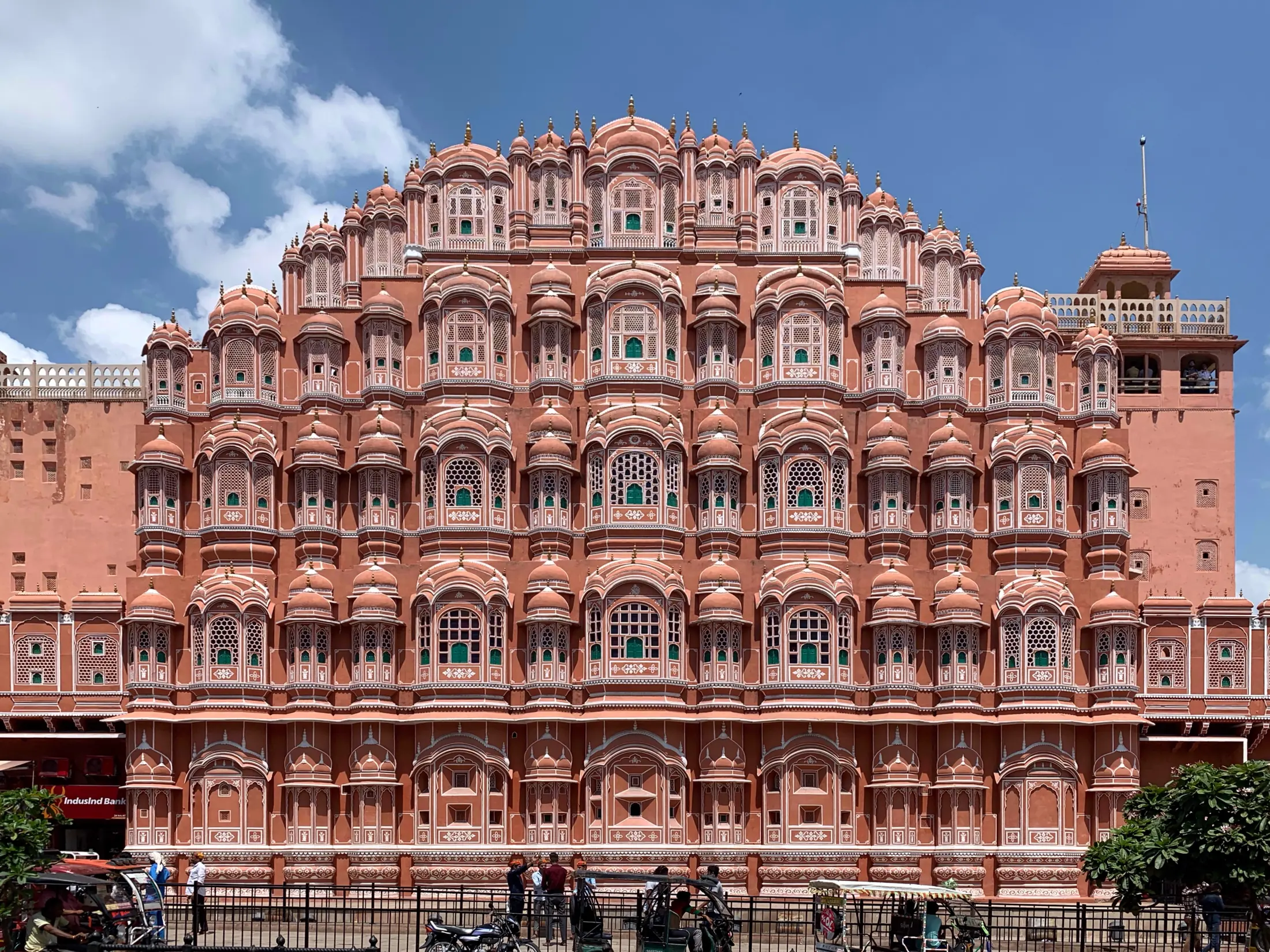
Markets drawn on a map
Planned with the palace: when Sawai Jai Singh II founded Jaipur in 1727, he laid out the bazaars at the same time as his palace.
Built to a pattern: broad straight streets between the city's rectangular blocks, lined with uniform rows of shops behind arcaded verandahs, with houses and workshops above.
The squares: where the main streets crossed, he set great squares called chaupars.
- Planned
- 1727, with the city itself
- Planned by
- Sawai Jai Singh II
- Lanes
- One trade to each rasta
- Painted pink
- 1876, kept by law
- UNESCO
- Walled city listed in 2019
- An open invitation: the king invited merchants, bankers and craftsmen from across India to settle, offering land and protection. Many came, and their descendants are still here.
- A lane for each trade: each trade had its own rasta. Jewellers settled along Johari Bazaar, johari meaning jeweller.
- The bangle lane: bangle-makers worked on Maniharon ka Rasta, the lane of the manihar, the bangle-makers.
- Everyone else: brass and copper went to Tripolia, booksellers to Chaura Rasta, and the families who carved marble images of the gods to the lanes off Chandpole.
- Still sorted by trade: three centuries later the pattern has blurred but never vanished. You can still find thirty shops in one lane selling exactly the same thing, just as the king intended.
- The pink came later: in 1876 Maharaja Ram Singh II had the walled city painted to welcome the Prince of Wales. Shopfronts must keep the colour by law.
- World Heritage: in 2019 the walled city, bazaars and all, became a UNESCO World Heritage Site.
- Read on: our page on Jaipur tells the city's story, and our piece on why Jaipur is pink explains the colour.
How to read the bazaars
One long spine: from Chandpole Gate in the west, along Chandpole Bazaar to Choti Chaupar, then Tripolia Bazaar past the triple-arched Tripolia Gate of the City Palace, to Badi Chaupar beside Hawa Mahal.
And on east: from Badi Chaupar it continues as Ramganj Bazaar to Ramganj Chaupar and on towards Surajpol, the gate of the sun.
The backbone: that line is about the length of a long morning's walk, and it is the backbone of Jai Singh's city.
- The spine
- Chandpole Gate east to Surajpol
- Squares
- Choti, Badi and Ramganj Chaupar
- Southern wall
- Bapu and Nehru Bazaar
- Length
- A long morning's walk
- Crossing at Badi Chaupar: Johari Bazaar runs south to Sanganeri Gate, and Siredeori Bazaar runs north beneath the windows of Hawa Mahal.
- Crossing at Choti Chaupar: Kishanpole Bazaar runs south to Ajmeri Gate, and Gangauri Bazaar north towards the palace quarter.
- Along the southern wall: inside the gates, Bapu Bazaar and Nehru Bazaar link Sanganeri Gate, New Gate and Ajmeri Gate.
- The small lanes: between them all run the smaller lanes, each with its trade.
- Never lost for long: tell a rickshaw driver Badi Chaupar or Choti Chaupar and you know where you are. Any lane will, sooner or later, bring you out on a main bazaar.
- Napkin maps: our guides draw it for guests on a napkin at breakfast. By evening, most of them could guide us.
- The families: Hindu, Jain and Muslim families have traded side by side here since the city was founded.
- Generations deep: many shops have passed from father to son, and increasingly to daughter, for six or seven generations. Ask how long a family has been here and you often hear centuries.
Bazaar by bazaar
- Jewellery
- Johari Bazaar and its lanes
- Lac bangles
- Maniharon ka Rasta
- Block prints
- Bapu and Nehru Bazaar
- Marble
- Khajane Walon ka Rasta
- Fixed prices
- Rajasthali, MI Road
Johari Bazaar, the jewellers' street
Why it matters: Jaipur is one of the world's great centres for cutting and trading coloured gemstones, especially emeralds, and this is its old heart.
- On the main street: jewellers, sari shops and sweet shops, among them LMB, the old Laxmi Mishthan Bhandar.
- In the lanes behind: in Gopalji ka Rasta and Haldiyon ka Rasta you can watch gem cutters at work, and may see dealers trading stones from folded paper packets.
- When and how: late afternoon, when the street is liveliest, with a guide who knows which family firms to trust.
Siredeori Bazaar, beneath Hawa Mahal
Where: north from Badi Chaupar, under the famous facade.
- What's sold: brass lamps, puppets, turbans, wedding cards and household goods.
- Why go: one of the best streets for simply watching the city go by. Come at sunrise for Hawa Mahal and return in the evening for the shops.
Tripolia Bazaar and Maniharon ka Rasta
On Tripolia: brass, steel utensils, iron and household goods for Jaipur's families.
- The treasure: the side lane of Maniharon ka Rasta, where families shape lac bangles over small charcoal fires and press glass and stones into the soft lac while it is warm.
- A free show: watching a craftsman roll, twist and decorate a bangle in a few minutes is one of the best in Jaipur. Buy a set straight from the maker.
Chaura Rasta, the street of books
Where: running south from Tripolia.
- What's here: booksellers and stationers, busiest in the weeks before school exams, when students crowd in for guides and notebooks.
- Why go: old maps, postcards and printed things, and a glimpse of everyday Jaipur rather than its tourist face.
Chandpole Bazaar and Khajane Walon ka Rasta
Where: the west of the walled city, running to the gate of the moon.
- The name: Khajane Walon ka Rasta is named after the treasury officials who once lived here.
- What's made: marble work, from small carved images of the gods to garden pieces, along with tailors and cloth shops. The sound of chisels carries down the lane.
Kishanpole Bazaar
Where: running south from Choti Chaupar.
- Known for: textiles, tie-dyed fabrics, wooden crafts and the cool sherbets of its old drink shops.
- Why go: less visited than Johari Bazaar, and more local for it.
Bapu Bazaar and Nehru Bazaar
Where: inside the southern wall, near Sanganeri Gate and New Gate.
- What to buy: block-printed cotton by the metre, embroidered mojari slippers, bandhani dupattas, bags and the famously light Jaipuri quilts called razai.
- What to expect: busy, cheerful and good value. Prices are fixed in some shops and negotiable in most.
MI Road, outside the walls
The name: Mirza Ismail Road, after a twentieth-century prime minister of Jaipur State, running outside the southern wall.
- What's here: some of the city's oldest restaurants and the famous Lassiwala.
- Rajasthali: the government handicrafts emporium, useful for seeing fair fixed prices before you shop in the bazaars.
What to buy, and what to look for
- Kundan
- Gems set in pure gold foil
- Meenakari
- Bright enamel on gold and silver
- Block prints
- From Sanganer and Bagru
- Blue pottery
- Quartz paste, cobalt and turquoise
- Razai
- Featherlight cotton quilts
Gemstones and jewellery
What's cut here: emeralds, rubies, sapphires, garnets and many semi-precious stones.
- Two famous techniques: kundan, gems set in pure gold foil, and meenakari, bright enamel on gold and silver.
- Buy safely: only from established family jewellers who give a written description and certification for valuable stones.
- Read first: our gem shopping tips and guide to Rajasthani jewellery.
Block prints and textiles
Where it comes from: hand block-printed cotton from Sanganer and Bagru, just outside the city, sold by the metre and as quilts, tablecloths and clothes.
- Tell it's hand-made: look for slight irregularities in the print. Our block print buying guide shows you how.
- See it made: a morning with a printing family in Bagru is the best introduction.
Leheriya and bandhani
Leheriya: the wave pattern of Rajasthan's tie-dye. Bandhani: its tiny resist-dyed dots. Both are worn for festivals and weddings.
- When to look: in the monsoon before Teej, Johari Bazaar fills with leheriya saris and turbans.
- Learn more: our page on leheriya and bandhani explains the craft.
Blue pottery
What it is: Jaipur's own craft, made from a quartz paste rather than clay and painted in cobalt and turquoise.
- Travelling with it: fragile but beautiful. Good shops will pack it well.
- What to look for: our blue pottery buying guide explains.
Lac bangles
- Buy from the maker: on Maniharon ka Rasta, one of the most joyful and affordable things you can carry home.
- Made to size: have a set made while you wait.
Mojaris and juttis
What they are: embroidered leather slippers, pointed at the toe.
- Where: Bapu Bazaar, Johari Bazaar and the lanes around them.
- Fit: leather softens with wear, so buy snug. Our piece on mojari shoes has more.
Razai quilts
- What they are: Jaipuri quilts filled with cotton so light and finely carded that a full-size quilt folds into a small bag.
- Why buy one: warm, beautiful and very Jaipur.
Rugs, marble and brass
- Masters of each: hand-knotted rugs, carved marble from the workshops off Chandpole, and brass lamps and vessels from Tripolia.
- Before buying a rug: read our guide on how to buy a rug.
The commission trap, and how to avoid it
How it works: many drivers, guides and touts in Jaipur earn a commission on everything you buy in the shops they take you to, often a large share of the price.
The showrooms: usually comfortable, air-conditioned and full of beautiful things, with prices raised to pay for the commission.
- Who earns it
- Many drivers, guides and touts
- Who pays
- You, in raised prices
- Our guides
- Paid never to take a share
- Gem scam
- Never buy or carry stones for strangers
- The real cost: the goods are not bad. You pay far too much, and the city's real craftsmen see very little of it.
- Our way: our guides are paid never to play this game. We take guests to family jewellers, printers and potters we have known for decades, and never take a share.
- Say no politely: if any driver, guide or friendly stranger suggests a shop, a special sale or a factory visit, decline firmly.
- How we choose: our shopping guide explains the places we trust.
- The gem export scam: friendly strangers have approached travellers with a story about exporting gems, asking them to carry stones abroad or buy them to resell at home. It always ends badly for the traveller.
- Three rules: never buy gems from a stranger, never agree to carry anything for anyone, and never buy a stone you cannot have independently tested.
How to bargain like a Jaipur auntie
The opening: ask the price, look a little longer, and offer what feels fair to you.
The conversation: the shopkeeper will laugh, tell you about his costs and his children, and come down. You come up.
- Negotiable
- Most small bazaar shops
- Fixed price
- Rajasthali on MI Road, some others
- Payment
- UPI and cards widely, cash in the lanes
- Carry
- Small notes
- The walk-away: if no price pleases you both, smile, say thank you and walk away. Very often you will be called back.
- Go easy on small things: a set of bangles or a printed scarf made by hand, where a few rupees matter more to the maker than to you.
- Take your time on big ones: jewellery, rugs and textiles in quantity. Compare a few shops first.
- Know fair value: fixed-price shops, including Rajasthali on MI Road, give you a useful sense of it.
- Paying: many shops accept UPI phone payments and cards, but cash still matters in the smaller lanes.
- Shipping: established shops can ship abroad, though we suggest carrying the most precious pieces with you. See money and tipping.
Eating your way through the bazaars
Morning kachori: pyaaz kachori, a flaky pastry stuffed with spiced onion, from one of the old sweet shops, then chai in a clay cup.
Lassi on MI Road: at Lassiwala it is thick enough to stand a spoon in, and sells out by lunchtime.
LMB in Johari Bazaar: sweets and vegetarian meals for generations.
- Breakfast
- Pyaaz kachori and chai in a clay cup
- Lassi
- Lassiwala on MI Road, before lunch
- Seasonal sweet
- Ghevar, before Teej
- Evening
- Masala Chowk beside Albert Hall
- Ghevar season: in the monsoon before Teej, LMB sells ghevar, the honeycomb disc of fried batter soaked in syrup that Jaipur eats only at that time of year.
- Read about each: our pieces on pyaaz kachori, lassi in Jaipur and ghevar and Teej.
- Masala Chowk: outside the walls beside Albert Hall, some of the old city's best-known street-food stalls gathered in one clean courtyard.
- In the bazaars: kulfi sellers, roasted corn and chaat cooked to order.
- Eat safely: choose busy stalls where food is cooked in front of you, avoid anything raw that has been sitting out, and drink bottled or filtered water.
- The full list: our food of Jaipur guide.
The best hours and the best seasons
Early morning: the bazaars belong to sweepers, milkmen, temple bells and the smell of frying kachori. Best for architecture and photographing the arcades without crowds.
Late morning: most shutters lift.
- Early morning
- Walking and photographs, not shopping
- Shutters lift
- Late morning
- Best shopping
- Late afternoon into the evening
- Best season
- October to March
- Most spectacular
- The weeks before Diwali
- Late afternoon into evening: the best shopping, when the heat has gone, the lights come on and the whole city is out. See bazaars after dark.
- October to March: the most comfortable season.
- Before Diwali: in October or November, Johari Bazaar, Bapu Bazaar and MI Road are lit end to end, with families buying clothes, gold and sweets. See Diwali.
- Before Makar Sankranti: in January, kite sellers spring up across the old city.
- Before Teej: in the monsoon season the bazaars fill with leheriya and ghevar. See Teej.
- Wedding season: in winter, brides and their families hunt for jewellery and saris, and the bazaars are at their busiest and happiest.
How to visit the bazaars
Walk with a local guide: one who grew up in the walled city knows the lanes, the families and the prices, and will never take you to a commission shop. Our heritage walks begin in the bazaars.
Wear closed shoes: the pavements are uneven, and you'll share the road with scooters, cows and the occasional handcart.
- Guide
- One who grew up in the walled city
- Shoes
- Comfortable and closed
- Long stretches
- Cycle rickshaw
- Photography
- Ask shopkeepers first
- Take a cycle rickshaw: for the long stretches. It is slow, gentle and lets you see the arcades from a little above the crowd.
- Keep valuables close: busy bazaars attract pickpockets, as they do anywhere in the world.
- Dress modestly and comfortably: women travellers will find the bazaars friendly, and our page for women travellers has more advice.
- Ask before photographing: most shopkeepers and craftspeople are happy to be photographed at work if you take an interest first.
- Take breaks: drink plenty of water. A rooftop cafe or a cool sweet shop is never far away.
What most visitors miss
The upper floors
- Look up: above the shops, the old houses still have carved balconies, painted walls and tiny shrines.
- Ask for a rooftop: your guide can take you up for the view across the pink arcades.
The temples in the lanes
- Every few hundred metres: a small temple opens off the bazaar, with bells, marigolds and a priest dozing in the shade.
- Step in quietly: remove your shoes, and you'll see how the bazaar and the sacred are woven together.
The craftsmen at work
- Behind the shopfronts: gem cutters at their wheels, tailors at old sewing machines, bangle-makers at their fires.
- Knowing the doors: a good guide knows which ones to knock on.
The squares at dusk
- What you'll see: Badi Chaupar and Choti Chaupar fill with pigeons, flower sellers and families out for kulfi.
- Where to sit: a rooftop across from Hawa Mahal with a cup of chai, watching the walls turn from pink to rose.
A bazaar walk the way we do it
- Start
- Choti Chaupar, early morning
- Midday
- Lunch and a rest at your hotel
- Finish
- Masala Chowk, after dark
- Length
- A half day plus the evening
Morning, the old trades
Start: at Choti Chaupar as the vegetable sellers set up.
- Walk east: along Tripolia Bazaar, turning into Maniharon ka Rasta to watch the bangle-makers.
- Stop and continue: kachori and chai, then on to Badi Chaupar and the facade of Hawa Mahal.
Late morning, the jewellers
Turn south: down Johari Bazaar.
- With your guide: the gem cutters in Gopalji ka Rasta, then a family jeweller we trust.
- Then rest: lunch and a rest at your hotel.
Afternoon and evening, textiles and food
Late afternoon: Bapu Bazaar and Nehru Bazaar for block prints, mojaris and quilts.
- As the lights come on: walk out through the gate to Albert Hall, lit up in its garden. The Albert Hall Museum page has more.
- Finish: street food at Masala Chowk.
Where to stay close to the bazaars
Samode Haveli
- What it is: a nobleman's haveli inside the walled city, with painted rooms, a garden pool and a terrace for the evening.
- Why stay: walk out of the gate and you are in the old city in minutes.
The Raj Palace
- What it is: a restored nobleman's palace near the northern gates of the walled city.
- Why stay: a short drive or rickshaw ride to the bazaars.
Rambagh Palace and Jai Mahal Palace
Where: Rambagh Palace and Jai Mahal Palace are a short drive from the southern gates.
- Why stay: after a day in the bazaars, their gardens are a welcome calm.
- Compare them all: our guide to luxury hotels in Jaipur.
Who will love the bazaars, and who won't
Shoppers, designers and photographers: and anyone who loves street life will want at least two half days, one for the old trades and one for textiles and jewellery.
- If crowds wear you out: walk the bazaars early, before the shops open, and keep serious shopping for one or two trusted family shops.
- Families with children: enjoy the bangle-makers, the kite sellers and the sweets. A cycle rickshaw ride is usually the highlight.
- Limited mobility: you can see a good deal from a rickshaw or car, with short walks into the lanes.