
Why a country noble needed a house in town
1727: when Sawai Jai Singh II moved his capital from Amer to the new city of Jaipur, the nobles followed him.
Estates for service: they held their country estates, their thikanas, from the king in return for loyalty, soldiers and service at court.
A house at court: space within the walls was allotted by rank and favour, and the great families built havelis, courtyard mansions turned inward against the street.
- Built for
- The Rawals of Samode, at court
- Credited to
- Rawal Sheo Singh, mid-19th century
- The family
- Nathawats, a Kachwaha branch
- Setting
- North-east walled city, near Gangapole
- Run by
- The Samode family
- Good for
- Walkers, festivals, character
- Inside a haveli: rooms for the family, for guests and for the women of the household.
- The Samode family: Nathawats, a branch of the Kachwaha clan that ruled Amer and Jaipur. They held the title of Rawal and served the Jaipur kings as soldiers and ministers for generations.
- Country seat and city house: their seat was the fort-palace at Samode, in the Aravalli hills about an hour north. Their city house is Samode Haveli.
- Rawal Sheo Singh: the family credits the haveli to him. He served many years as prime minister of Jaipur state in the mid-nineteenth century, and added the painted Durbar Hall to Samode Palace.
- Its age: sources differ, and parts may be older or later than his time, as usual with houses families lived in and altered for generations.
- Its purpose: the family's base at court, to receive visitors, stay for festivals and ceremonies, and keep a foot in the capital's politics.
- Today: the family runs it as a heritage hotel, with Samode Palace and the garden camp of Samode Bagh. Our pieces on rawlas and thikanas and what a haveli is explain more.
Inside the haveli

Arriving
The lane: a busy one in the north-east of the walled city, near the old Gangapole gate, then a forecourt.
- Then the house opens: courtyards, arcades, painted walls and a garden with a swimming pool.
- The quiet: the first thing you notice. Thick walls and an inward-looking plan were designed to keep the street out, and they still do.
How a haveli worked
The outer rooms: near the gate, for men's business: receiving visitors, holding meetings, dealing with the estate.
The zenana: deeper inside, around their own courtyards, the women's quarters, private from the street and from strangers.
- Roofs and terraces: for sleeping on hot nights and flying kites in January.
- The courtyard: pulled cool air through the house in the evening.
- Read the plan: the public front, the private heart and the terraces above.
The painted rooms
The walls: in parts of the house, walls and ceilings are painted with flowers, vines, birds and geometric borders, in the style of Rajasthan's courtly murals.
- The dining room: covered in murals. Dinner there by lamplight shows them at their best.
- The mirror suite: one suite has walls set with mirror work and coloured glass, of the kind the Rajputs loved. Guests ask about it long after they leave.
- Everywhere else: jharokha windows, carved doors, old furniture and family portraits. This is a house people lived in.
Rooms and realities
Rooms vary a great deal: some large and painted, some smaller and simpler. Some open onto the courtyard, others onto the garden or terraces.
- How we choose: we know the house and choose specific rooms. Tell us whether decoration, light, quiet or closeness to the pool matters most.
- An old building: stairs and steps, thresholds to watch, and sound that carries across a courtyard.
- A working city: you may hear a temple bell, a wedding band or the call to prayer. For us that is part of the pleasure. Light sleepers should tell us, and we choose a room away from the street.
Waking up inside the walls
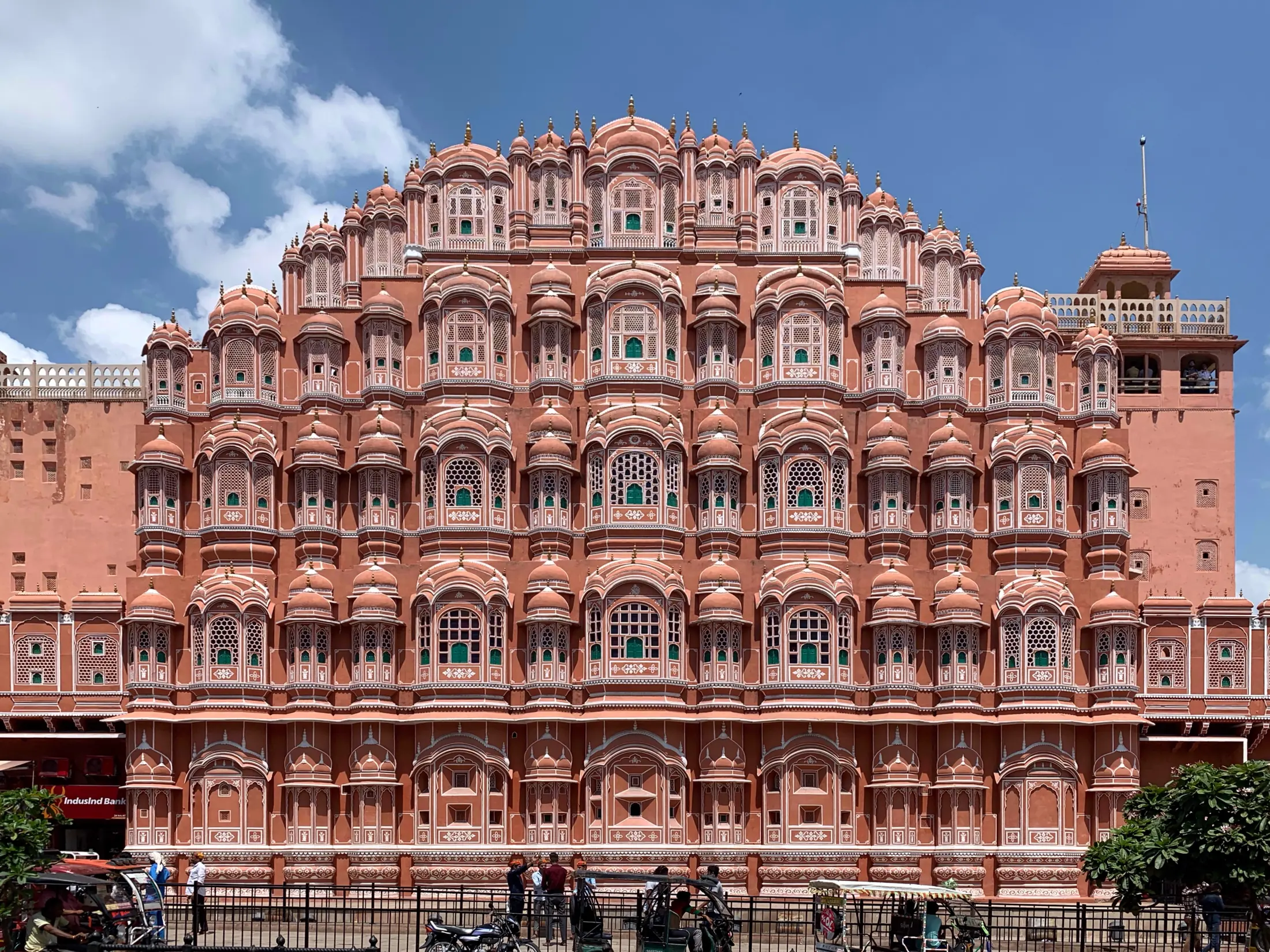
Walk out at dawn and the shutters are still down. Tea stalls are lighting their stoves, women are leaving marigolds at the corner shrines, and the pink walls are soft in the early light.
The reason to stay here: most visitors drive in at nine, see the walled city at its most crowded and drive out again. Staying inside, you see the hours it keeps for itself.
- Hawa Mahal at sunrise: Hawa Mahal is a short drive or rickshaw ride away, and its facade glows at first light.
- Then the bazaars: walk on to Badi Chaupar, the great square, and into Johari Bazaar as the jewellers arrive.
- Street by street: with a guide who grew up here, follow the old trades: lac bangles on Maniharon ka Rasta, brass on Tripolia, books and stationery on Chaura Rasta.
- Read more: our guide to the bazaars of Jaipur explains how the old city sorts itself by craft.
- The luxury: a morning in the city, then a quiet garden ten minutes away when the heat and noise build.
- Out again at dusk: the bazaars light up and families come out for kulfi and chaat. Our heritage walks page describes the routes we use.
- On the Amer side: the haveli saves precious minutes on the early drive to Amber Fort.
Dinner on the terrace
The dining room: painted with murals and lit softly at night.
Outside: in the cool months, tables are set on the terraces and in the courtyard.
The kitchen: the food of the Rajput nobility alongside Indian and international dishes. Ask for the Rajasthani food.
- Laal maas: mutton in a fierce sauce of red Mathania chillies, from the hunting camps and royal kitchens of families like this one.
- Safed maas: the gentler white version, with cream and ground nuts.
- For vegetarians: gatte, ker sangri, and in winter a millet roti with white butter.
- Family dishes: those not on the menu can often be cooked with a little notice, so ask in the morning.
- Eating out: easy from the old city. Breakfast on pyaaz kachori and a clay cup of lassi is one of the great Jaipur rituals. Our food of Jaipur guide lists the institutions.
- A family kitchen: our page on a cooking class in a haveli describes how we arrange an afternoon in one.
The pool, the garden and the afternoon pause
The garden pool: one of the haveli's great pleasures.
Why it matters: Jaipur in October and March is warm, and in April it is hot. After a morning in the lanes, a swim and a long lunch in the shade make the evening possible.
- Favourite hours: many of our guests tell us the afternoons by the pool were the best of the trip.
- Massage: ask us when you book, and we will tell you what can be arranged during your stay.
- Not a destination spa: and we won't pretend it is. For a serious spa, pair the haveli with a night or two at The Oberoi Rajvilas, or read our page on spas and Ayurveda.
- Rest enough: for most guests, the garden, the pool and a good book.
Festivals from inside the walls

- Makar Sankranti
- 14 January
- Gangaur
- March or April
- Holi
- February or March
- Teej
- The monsoon
- Diwali
- October or November
Makar Sankranti, the kite festival
On 14 January: the whole walled city climbs onto its roofs, and the sky fills with paper kites from morning to night.
- Join in: on a rooftop with music, sweets and much shouting.
- At night: paper lanterns drift up over the city.
Gangaur and Teej
The processions: the women's festivals of Rajasthan end with royal processions from the City Palace out through Tripolia Gate.
- When: Gangaur falls in March or April and Teej in the monsoon. We confirm the dates each year.
- The advantage: from the haveli you can walk to the route rather than fight the traffic.
Diwali in the bazaars
- The lights: in October or November the bazaars light up end to end, and the walled city is at its most beautiful.
- On foot: staying inside the walls, you walk out after dinner and see it without a car.
Holi
- When: February or March, when the old city plays with colour. Joyful and chaotic.
- How we do it: we plan a gentle, safe way to join in, and the haveli's walls make a good refuge afterwards.
Two days from the haveli
Day one, the walled city on foot
Sunrise: walk out with your guide and watch the light come up on Hawa Mahal from a rooftop opposite, with a cup of masala chai.
The bazaars as they open: Johari Bazaar for the jewellers, the side lanes of Tripolia for lac bangles and brass, and kachori and lassi when you are hungry.
- Mid-morning: the City Palace as it opens and the Jantar Mantar as the sun climbs.
- Afternoon: walk home for lunch and the pool.
- Evening: out again as the light softens and families fill the squares, then dinner on the haveli terrace.
Day two, Amer and the ridge
Before dawn: leave for Amber Fort, close on this side of the city, and reach the gates as they open.
- On the way down: the stepwell of Panna Meena ka Kund, and a stop at Jal Mahal on the way home.
- Afternoon: rest through the heat of the day.
- Sunset: drive up to Nahargarh over the pink city, then back down into the lit bazaars for street food, or home for a quiet dinner.
Day three, on to Samode
- After a slow breakfast: drive an hour north through Chomu to Samode Palace.
- Arrive for lunch: rest, then climb to the old fort above the village in the evening light.
The haveli and the palace, a pair
At night the haveli hums: music from a wedding somewhere, a scooter in the lane, the bells of the evening aarti, the offering of light at the neighbourhood temple. At Samode, after dinner, you hear peacocks on the hill and then nothing. Both silences are part of Rajasthan.
One family, one Rawal: Samode Haveli and Samode Palace belong to the same family and were shaped by the same Rawal Sheo Singh.
- In the city: ceremonies, politics, the bazaars and the court.
- In the country: the village, the fields, the temple and the fort on the ridge.
- An easy journey: two nights at the haveli for the old city and Amer, then an hour's drive north through Chomu to Samode for one or two nights in the hills.
- In a single afternoon: you go from temple bells and bazaars to village silence.
- Add a camp night: many guests add Samode Bagh, the family's garden camp. Read our guide to Samode Palace for the country side of the story.
Who will love the haveli, and who won't
Walkers, photographers and the curious: the old city at dawn and dusk on your doorstep.
Character over polish: painted rooms, old furniture and a family house.
- Best for
- Walkers, photographers, the curious
- Also good for
- Couples, small groups, festivals
- Think twice
- Light sleepers, limited mobility
- Not for
- Big pools, destination spas
- Couples and small groups: the haveli's scale feels personal. Our heritage havelis trail is built for people like you.
- Festival travellers: especially for the kite festival, Gangaur and Diwali.
- Light sleepers: talk to us first. This is a house in a working city.
- Limited mobility: the stairs and steps may be difficult. Tell us, and we will check what is possible or suggest Jai Mahal Palace or a modern resort.
- Big pools and lawns: for a pool complex, a destination spa or acres of lawn, choose The Oberoi Rajvilas or Rambagh Palace.
How the haveli fits our journeys
Jaipur in three nights: on our Jaipur in three nights journey, the haveli makes every morning a walk.
- Longer routes: on the Royal Rajputana, it is the Jaipur stop for guests who want to be inside the walls, often followed by Samode Palace on the road north to Shekhawati.
- A single night: for families or light sleepers who prefer a resort, one night here in the middle of a stay elsewhere puts them at Hawa Mahal and Amber at first light without a long drive.
- Compare: our Jaipur luxury hotels guide covers every option, and our guide to heritage havelis sets Samode Haveli against the great haveli hotels of Rajasthan.
What we tell guests before they arrive
Shoes: pack ones you can walk in and slip off easily. You will walk more here than anywhere else in Jaipur, and take them off at every temple.
Small notes: for chai, rickshaws and temple offerings. Many shops take phone payments now, but cash still matters in the lanes.
- Dress modestly: shoulders and knees covered. The old city is a conservative, neighbourly place.
- Shop touts: say no, politely, to anyone who offers to take you to a shop. Our guides are paid never to take commission.
- Photographs: ask before photographing people, especially women, and accept a refusal with a smile.
- One greeting: khamma ghani, the Rajasthani hello. Use it at the gate, and the staff will teach you more.
Getting there and around
From the airport: around forty minutes, depending on traffic in the old city. We meet you at the aircraft door or the arrivals hall.
From Delhi: about four to five hours by road, or a little over four hours by fast train to Jaipur Junction, about twenty minutes away.
- Nearest airport
- Jaipur International, at Sanganer
- From the airport
- Around forty minutes
- From Delhi
- Four to five hours by road
- Railway station
- Jaipur Junction, about twenty minutes
- Amber Fort
- About half an hour at dawn
- Around the old city: Hawa Mahal and the bazaars are a short drive, a rickshaw ride or, for good walkers, a walk away.
- To Amer: Amber Fort is about half an hour north in the early morning.
- Inside the walls: we often leave the car and walk, or take a cycle rickshaw for the narrowest lanes. Your chauffeur meets you at the edge. Our guide to getting around Rajasthan explains more.
- Book well ahead: for the kite festival, Diwali and the winter season. The haveli is small and fills early.